
Route4Me Webhooks Settings and Activity Feed Callback URL
Route4Me’s Route Planner Webhooks enable third-party systems to receive real-time notifications about key system, driver, vehicle, and app events, including optimized routes, route changes, visited stops, completed deliveries, and proof of delivery collection. These notifications are triggered by events generated across Route4Me’s enterprise route optimization software, as well as Route4Me’s Android and iOS Route Planner mobile apps, providing continuous updates from route optimization and dispatch through driver navigation and delivery completion.
Table of Contents
Route4Me Route Planner Webhook Settings And Callback URL
To set up webhooks, go to “Settings” > “Organization Settings” from the Navigation Menu, and select “Activity Feed Webhook” under “Integrations“. Input your webhook URL (postback URL) into the “Callback URL” field and click “Save” to finalize.
Webhooks are configured at the Route4Me account owner level, meaning activity from the account owner, drivers, and all sub-users is automatically sent to the configured callback URL.
Route4Me supports up to 10 retry attempts if a request fails due to HTTP errors. Successful requests are identified by standard HTTP status codes such as 200, 201, 202, 204, 401, 403, 404, 405, and 406.
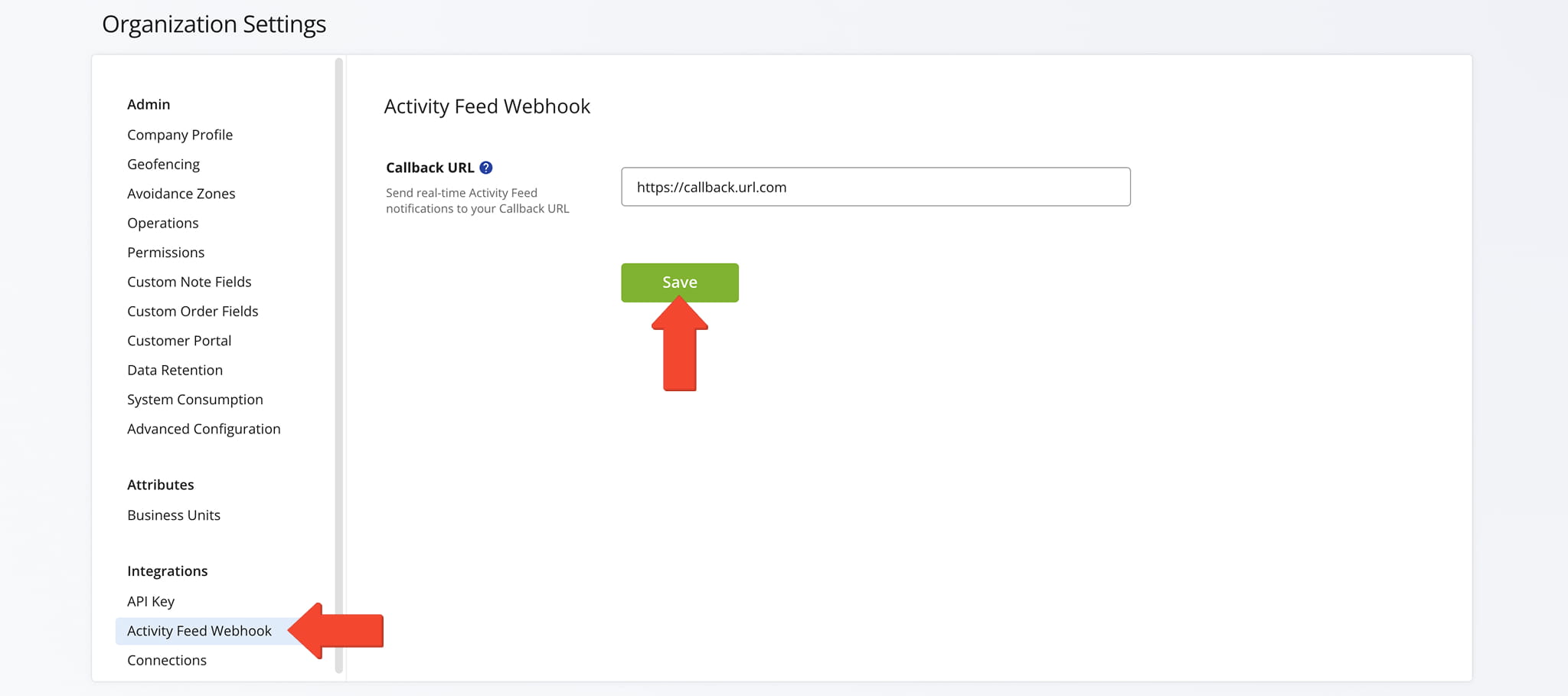
NOTE: To access the webhook settings, enable your account’s Audit Logging and Activity Stream Add-On.
Route4Me Route Planner Webhook Events And Samples Response
Below, you’ll find a list of Route4Me Activity Feed webhook trigger events, devices, and user types, along with sample webhook responses. These JSON examples show what data can be sent to your callback URL through automated real-time notifications.
Webhook Events & Sample Responses
A stop (address or location) was added or inserted into a planned route by the account owner or a sub-user from the Route4Me Web Platform, or the connected Android and iOS mobile apps.
The details of the route stop were changed and updated by the account owner or a sub-user from the Route4Me Web Platform, or the connected Android and iOS mobile apps. For example, stop details can include stop alias, address, customer details, order details, and more.
The stop was deleted from its planned route by the account owner or a sub-user using the Route4Me Web Platform, or the connected Android and iOS mobile apps.
The route stop was moved to another sequence position on its planned route by the account owner or a sub-user using the Route4Me Web Platform, or the connected Android and iOS mobile apps. For example, a stop was moved from the #5 to #10 sequence position on the route.
Driving, walking, or biking directions of the route were changed or updated by the account owner or a sub-user using the Route4Me Web Platform, or the connected Android and iOS mobile apps. For example, a new stop was added to the route, and then the route was re-optimized. Or, a stop was removed from the route, and then the route's directions were recalculated accordingly.
The route was marked as "Approved to Execute" by the account owner or a sub-user using the Route4Me Web Platform. When a route is Approved to Execute, the respective SMS and Email notifications can be automatically sent to the associated customers.
The route was marked as "Unapproved to Execute" by the account owner or a sub-user using the Route4Me Web Platform.
The geofence area set around the route stop was entered by the account owner or a sub-user using the Route4Me Web Platform, or the connected Android and iOS mobile apps, and the stop was automatically marked as "Arrived".
The geofence area set around the route stop was exited by the account owner or a sub-user using the Route4Me Web Platform, or the connected Android and iOS mobile apps, and the stop was automatically marked stop as "Done".
The route stop was marked as "Arrived" by the account owner or a sub-user using the Route4Me Web Platform, or the connected Android and iOS mobile apps.
Done Stop Status Assigned
The route stop was marked as "Done" by the account owner or a sub-user using the Route4Me Web Platform, or the connected Android and iOS mobile apps.
A note (with text, proof of delivery, file attachments, etc.) was added to the route stop by the account owner or a sub-user using the Route4Me Web Platform, or the connected Android and iOS mobile apps.
The route was duplicated (a copy of the route was created) by the account owner or a sub-user using the Route4Me Web Platform, or the connected Android and iOS mobile apps.
Two or more routes were merged into a single route by the account owner or a sub-user using the Route4Me Web Platform.
The route was optimized or re-optimized by the account owner or a sub-user using the Route4Me Web Platform, or the connected Android and iOS mobile apps. For example, you can optimize a new route or make changes to an existing route and then re-optimize it.
The route were changed and updated by the account owner or a sub-user using the Route4Me Web Platform, or the connected Android and iOS mobile apps. For example, the name of the route was changed, the route was re-scheduled, a new stop was added or an existing stop was removed, etc.
The route was deleted by the account owner or a sub-user using the Route4Me Web Platform, or the connected Android and iOS mobile apps.
Another user was re-assigned to the route (the route was dispatched to another user) by the account owner or a sub-user using the Route4Me Web Platform, or the connected Android and iOS mobile apps. When you assign a user to a route, this user gets access to the route and can see and optionally edit the given route based on their account-level permissions.
The vehicle was assigned to the route (the route was dispatched to the vehicle) by the account owner or a sub-user using the Route4Me Web Platform.
Another vehicle was re-assigned to the route (the route was dispatched to another vehicle) by the account owner or a sub-user using the Route4Me Web Platform.
The assigned vehicle was unassigned from the route (the route doesn't have an assigned vehicle now) by the account owner or a sub-user using the Route4Me Web Platform.
The route was started by the account owner or a sub-user using Route4Me's connected Android or iOS mobile app. After starting the route, the route's user can navigate the route, mark route stops as Arrived and Done, etc.
The route was paused by the account owner or a sub-user using Route4Me's connected Android or iOS mobile app. After pausing the route, the route's user can't navigate the route, mark route stops as Arrived and Done, etc.
The route was paused and then resumed by the account owner or a sub-user using Route4Me's connected Android or iOS mobile app. After resuming the route, the route's user can continue navigating the route, marking route stops as Arrived and Done, etc.
The route was ended by the account owner or a sub-user using Route4Me's connected Android or iOS mobile app. After pausing the route, the route's user can't navigate the route, mark route stops as Arrived and Done, etc.
The route stop was marked as "Arrived" or its geofence was entered earlier than the stop's Planned Arrival Time by the account owner or a sub-user using the Route4Me Web Platform, or the connected Android and iOS mobile apps. In other words, the stop's Actual Arrival Time is earlier than its Planned Arrival Time.
The route stop was marked as "Done" or its geofence was entered later than the stop's Planned Arrival Time by the account owner or a sub-user using the Route4Me Web Platform, or the connected Android and iOS mobile apps. In other words, the stop's Actual Arrival Time is later than its Planned Arrival Time.
The account owner or a sub-user sent a message in Route4Me's Activity Feed Live Chat using the Route4Me Web Platform, or the connected Android and iOS mobile apps.
A new order was created or generated by the account owner or a sub-user using the Route4Me Web Platform, or the connected Android and iOS mobile apps.
The details of the order were changed and updated by the account owner or a sub-user using the Route4Me Web Platform. Order details can include order alias, customer details, orders manifest, and more.
The order was geocoded (assigned latitude and longitude coordinates) by the system. For example, when an order with an address is imported into the Route4Me system using API, the given order is automatically geocoded.
The order's Scheduled For" date was changed by the account owner or a sub-user using the Route4Me Web Platform.
The order was deleted by the account owner or a sub-user using the Route4Me Web Platform, or the connected Android and iOS mobile apps.
The new Orders Territory was created by the account owner or a sub-user using the Route4Me Web Platform. Orders Territories are virtual areas set around order addresses and locations on the map that can be used for order management, route planning, etc.
The details of the Orders Territory were updated by the account owner or a sub-user using the Route4Me Web Platform. For example, the name of the territory was updated.
The Orders Territory was deleted by the account owner or a sub-user using the Route4Me Web Platform.
A new Address Territory was created by the account owner or a sub-user using the Route4Me Web Platform. Address Territories are custom-shaped virtual areas set around addresses and locations on the map that can be used for address management, route planning, etc.
The details of the Address Territory were updated by the account owner or a sub-user using the Route4Me Web Platform. For example, the name of the territory was updated.
The Address Territory was deleted by the account owner or a sub-user using the Route4Me Web Platform.
The new Avoidance Zone was created by the account owner or a sub-user using the Route4Me Web Platform. Avoidance Zones are virtual areas on the map that include addresses avoided by planned and optimized routes.
The details of the Avoidance Zone were updated by the account owner or a sub-user using the Route4Me Web Platform. For example, the name of the Avoidance Zone was updated.
The Avoidance Zone was deleted by the account owner or a sub-user using the Route4Me Web Platform.
The route stop was assigned the "Skipped" status by the account owner or a sub-user using Route4Me's Android or iOS mobile app.
The route stop was assigned the "Failed" status by the account owner or a sub-user using Route4Me's Android or iOS mobile app.
The route stop was assigned the "Done" status by the account owner or a sub-user using the Route4Me Web Platform, or the connected Android and iOS mobile apps.
The route stop was assigned the "Done" status by the account owner or a sub-user using the Route4Me Web Platform, or the connected Android and iOS mobile apps.
The status of the route stop was cleared by the account owner or a sub-user using the Route4Me Web Platform, or the connected Android and iOS mobile apps.
Visit Route4Me's Marketplace to Check Out Various Modules and Industry-Specific Subscription Packages:
- Route Optimization
Time Windows
- Route Optimization
Stops Bundling
- Route Optimization
Commercial Vehicle & Truck Routing
About author: Alex Yasko