
Route4Me API And SDK Docs – Route Optimization And ERP APIs And SDKs Documentation
Route4Me’s API is designed for medium and large enterprise businesses to automate route planning, import orders and addresses, and generate optimized last mile routes. Powered by a patented route optimization engine, Route4Me helps reduce miles, fuel consumption, manpower, and overall planning time.
Because these capabilities are delivered through a unified platform, a Route4Me API Integration provides a cost-efficient alternative to building and maintaining an in-house routing system, while supporting scalable deployment across major cloud providers including AWS, Google Cloud Platform, and Microsoft Azure.
By using Route4Me’s APIs and SDKs, businesses can capture and analyze routing data to gain actionable insights, supporting reporting and performance tracking across tools such as the Routes List and Dashboard. To help teams implement these capabilities, this guide provides the resources needed to get started and expand routing operations with Route4Me.
Table of Contents
Route4Me API Integration For Route Planning And Optimization
The Route4Me platform is powered by internal APIs that support web and mobile applications with real-time search, track and trace functionality, and advanced route optimization capabilities.
This includes dynamic routing capabilities such as continuous route re-optimization, scheduling constraints, route balancing, real-time rerouting, multi-destination navigation, dynamic ETAs, and advanced vehicle routing for Class 1–8 trucks with height, weight, tunnel, and bridge restrictions.
Route4Me API users can access these capabilities through a plug-and-play Logistics-as-a-Service platform, eliminating the need to build complex routing systems or manage underlying infrastructure. No software installation is required.
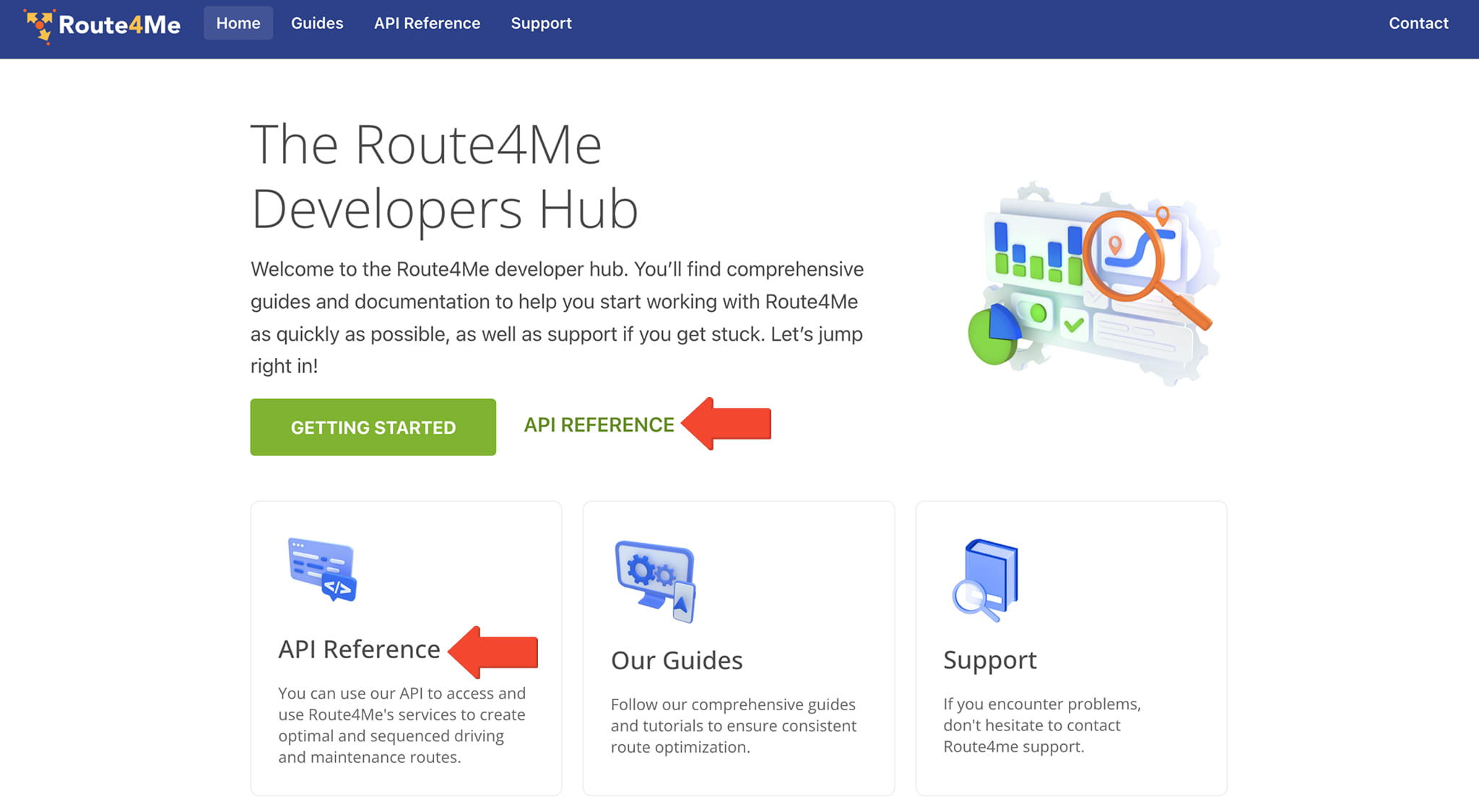
Detailed documentation for Route4Me APIs and SDKs is available in the Route4Me Developer Portal.
Access Route4Me Developer Portal
Route4Me API Endpoints Overview And Navigation
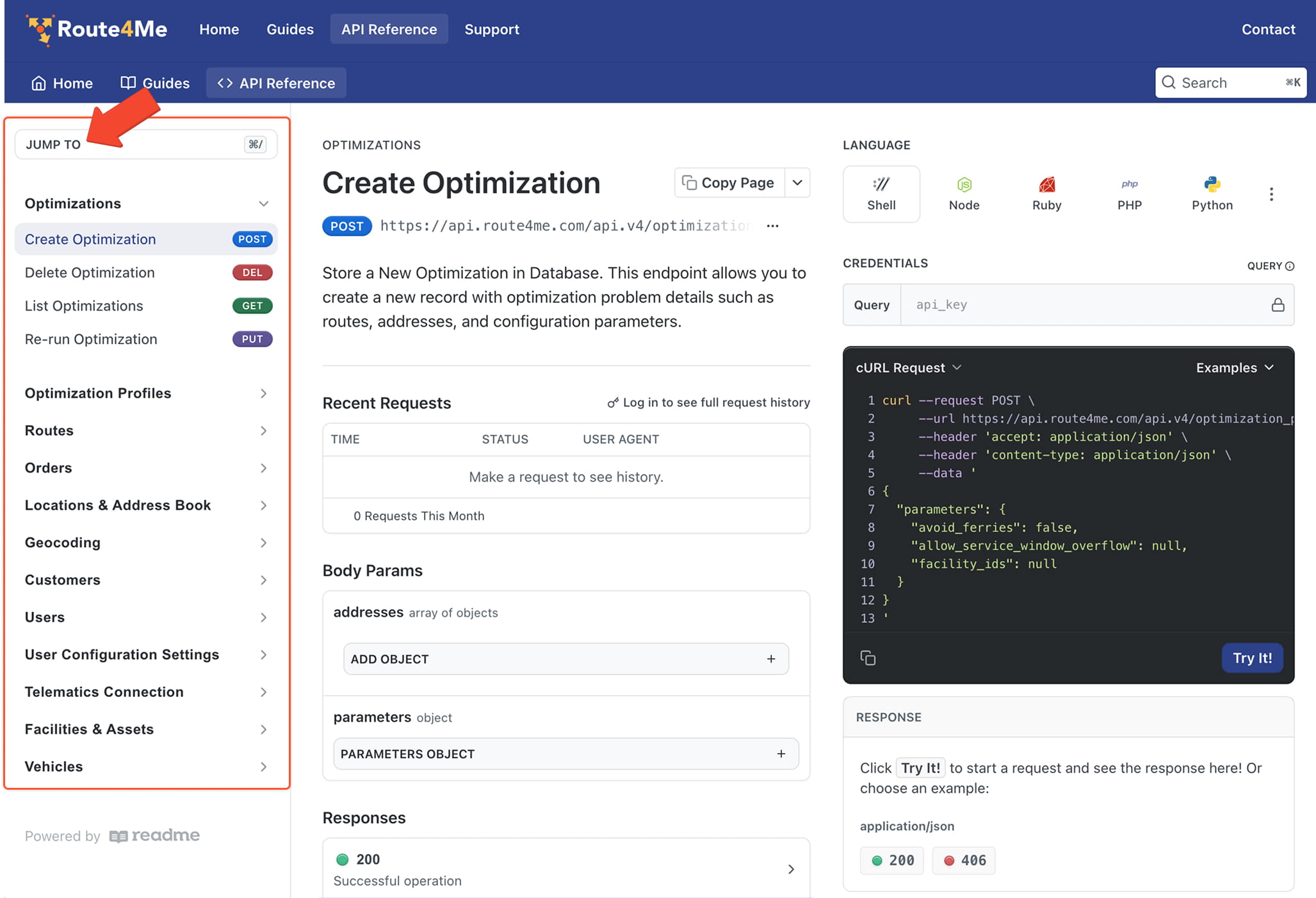
The Route4Me API Reference provides access to a complete set of API endpoints for routing, logistics, and last mile optimization.
These endpoints are organized by core platform areas such as routes, optimizations, orders, address books, users, vehicles, and integrations, allowing developers to manage all key routing operations through the API.
Use the “Jump To” search field to quickly filter and locate specific endpoints. Each endpoint supports standard HTTP methods such as GET, POST, and DELETE, enabling full control over creating, retrieving, updating, and deleting routing data.
Supported Languages And Technologies For Route4Me API Integration
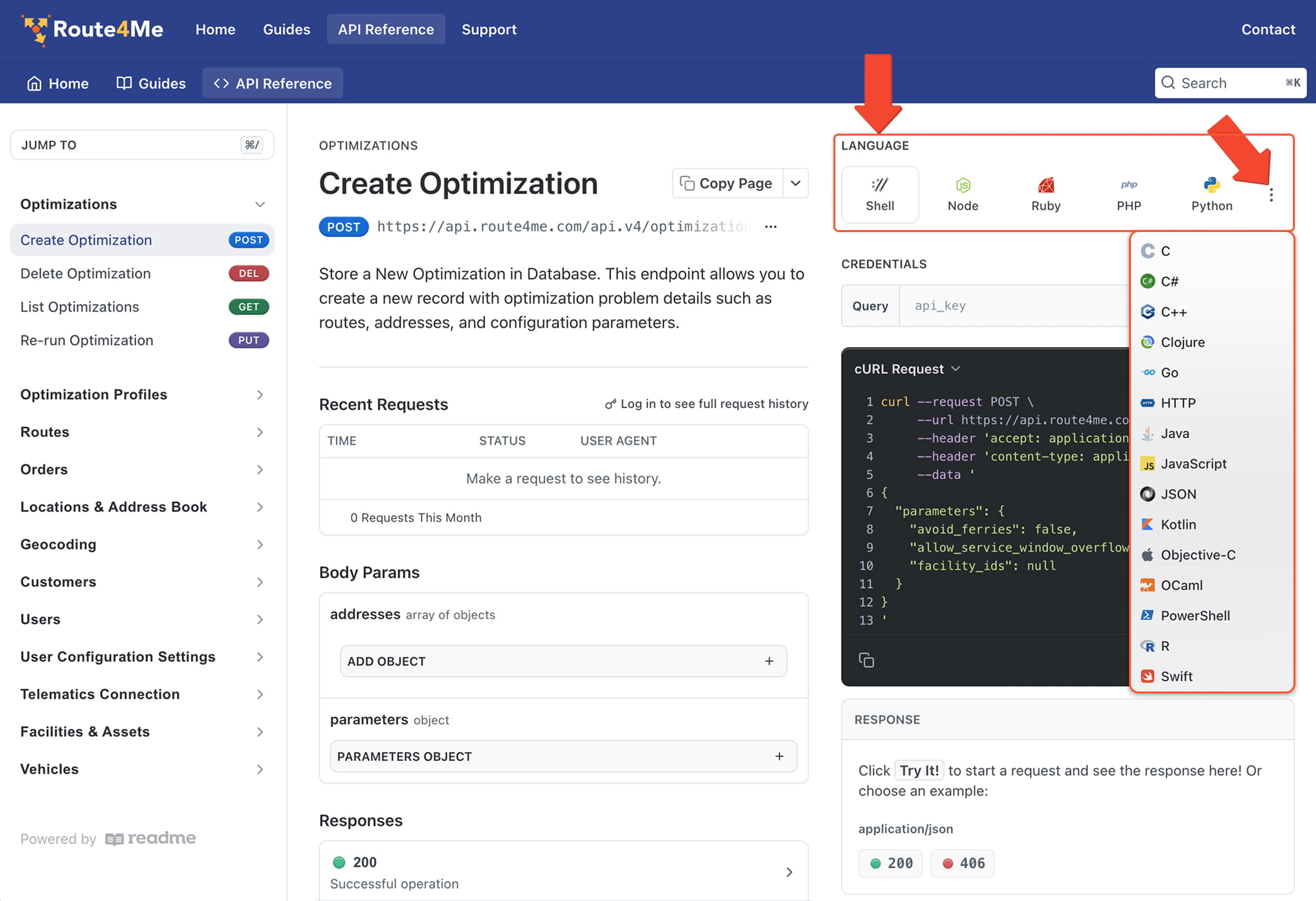
Route4Me’s API can be accessed using a wide range of programming languages, frameworks, and tools.
The table below outlines supported languages and technologies you can use to send requests, integrate routing functionality, and work with Route4Me API data.
Route4Me API Supported Languages
Test Route4Me EndPoints In The API Reference
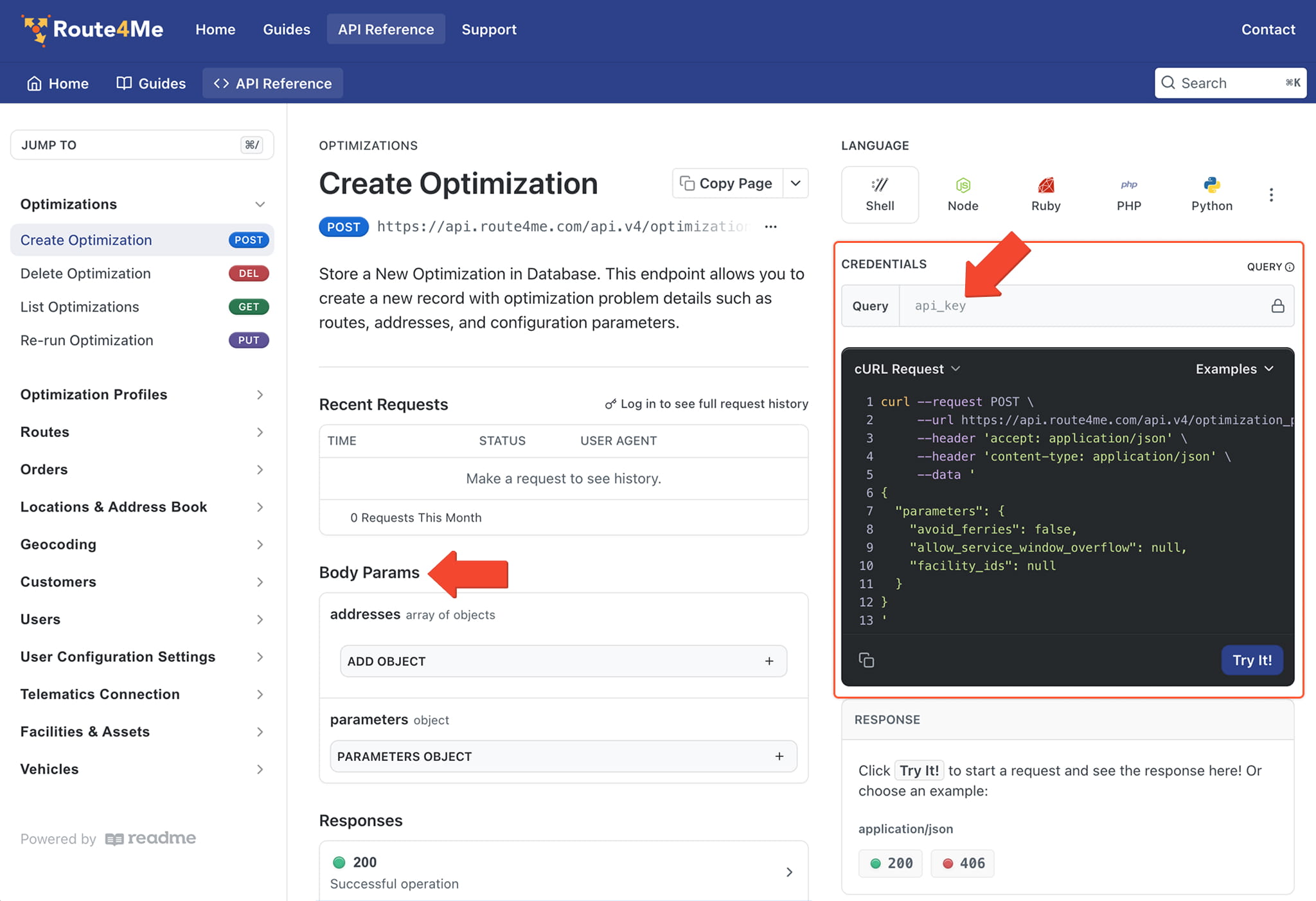
You can test Route4Me API endpoints directly from the API Reference by selecting an endpoint and entering your Route4Me API key in the credentials field.
Then, configure any required or optional parameters for the request, and run the call to view the results.
The response is displayed in the request output area and is also reflected in your Route4Me account, allowing you to verify data and behavior in real time.
Use SDKs To Interact With Route4Me APIs
Large enterprises invest heavily in logistics and supply chain optimization, but many legacy systems adapted for web use lack the flexibility and scalability of modern SaaS APIs and SDKs.
Route4Me, by contrast, is a cloud-native enterprise platform designed for high performance and scalability, using elastic scaling to deliver strong price-to-performance efficiency.
Route4Me combines geocoding, route optimization, planning, dispatch, execution, and post-route processes into a single integrated environment across the web platform and mobile apps, enabling seamless routing operations.
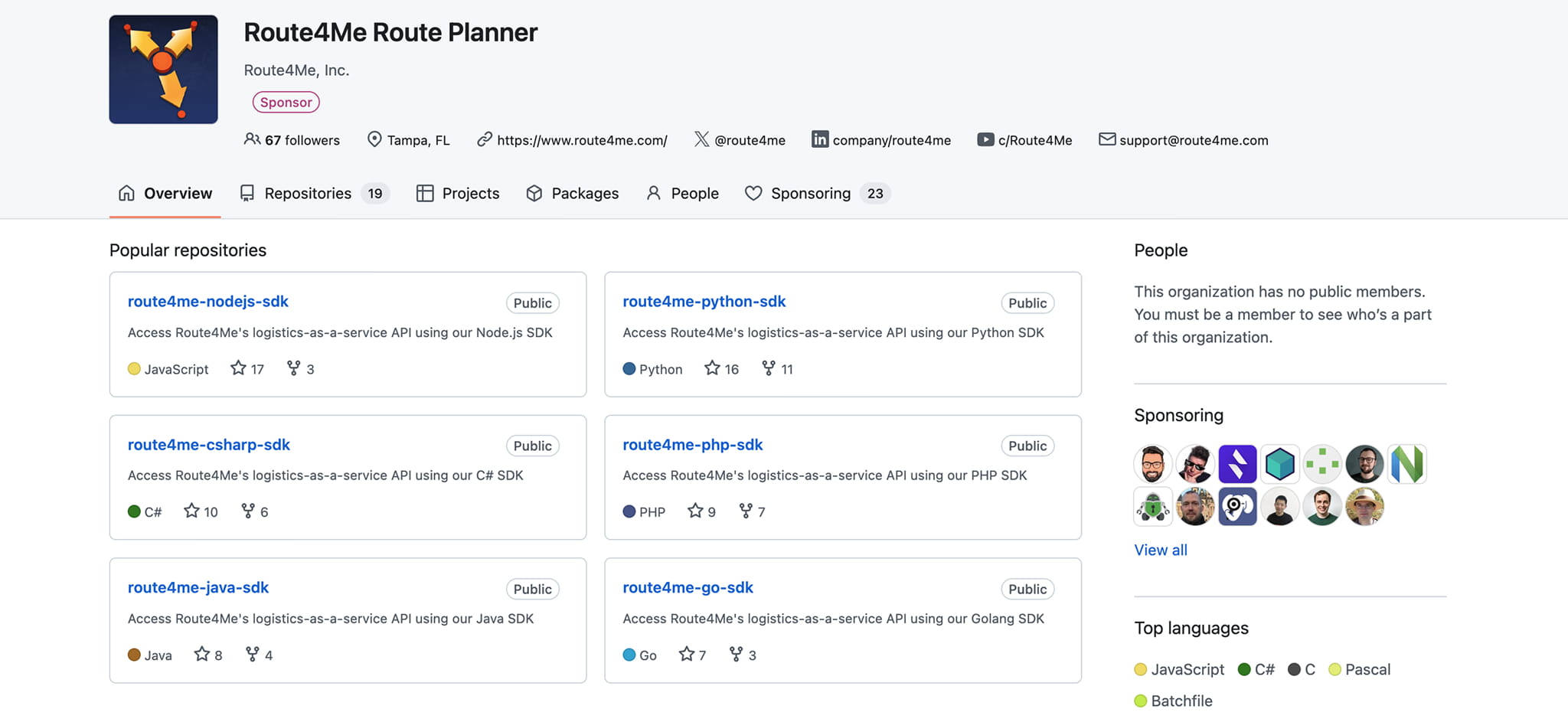
To support developers, the Route4Me SDK enables interaction with Route4Me APIs in multiple programming languages, making it easier to integrate routing functionality into existing systems and workflows without building complex routing logic from scratch.
Visit Route4Me's Marketplace to Check Out More Add-Ons and Modules:
- Route Optimization
Address Book and Territories Planning
- Operations
Custom Data Add-On
About author: Kristian Andreev