
Route Snapshot – Real-Time Customizable Route Data And Analytics Summary
Route4Me’s Route Snapshot gives you a clear, organized view of any last-mile optimized route. It brings all key metrics and route details together, including a route summary, map overview, route analytics, destinations data, orders, proof of visit records, and executed activities. With everything in one place, you can quickly review route performance, analyze data more effectively, and make informed decisions that help you deliver a better customer experience.
Table of Contents
Open Route Snapshot – Access Route Data And Analytics Overview Page
To open the Route Snapshot of any planned and optimized route, go to “Dynamic Routing” > “Routes” from the Navigation Menu to open the Routes Page. Then, click “Open” next to a route.
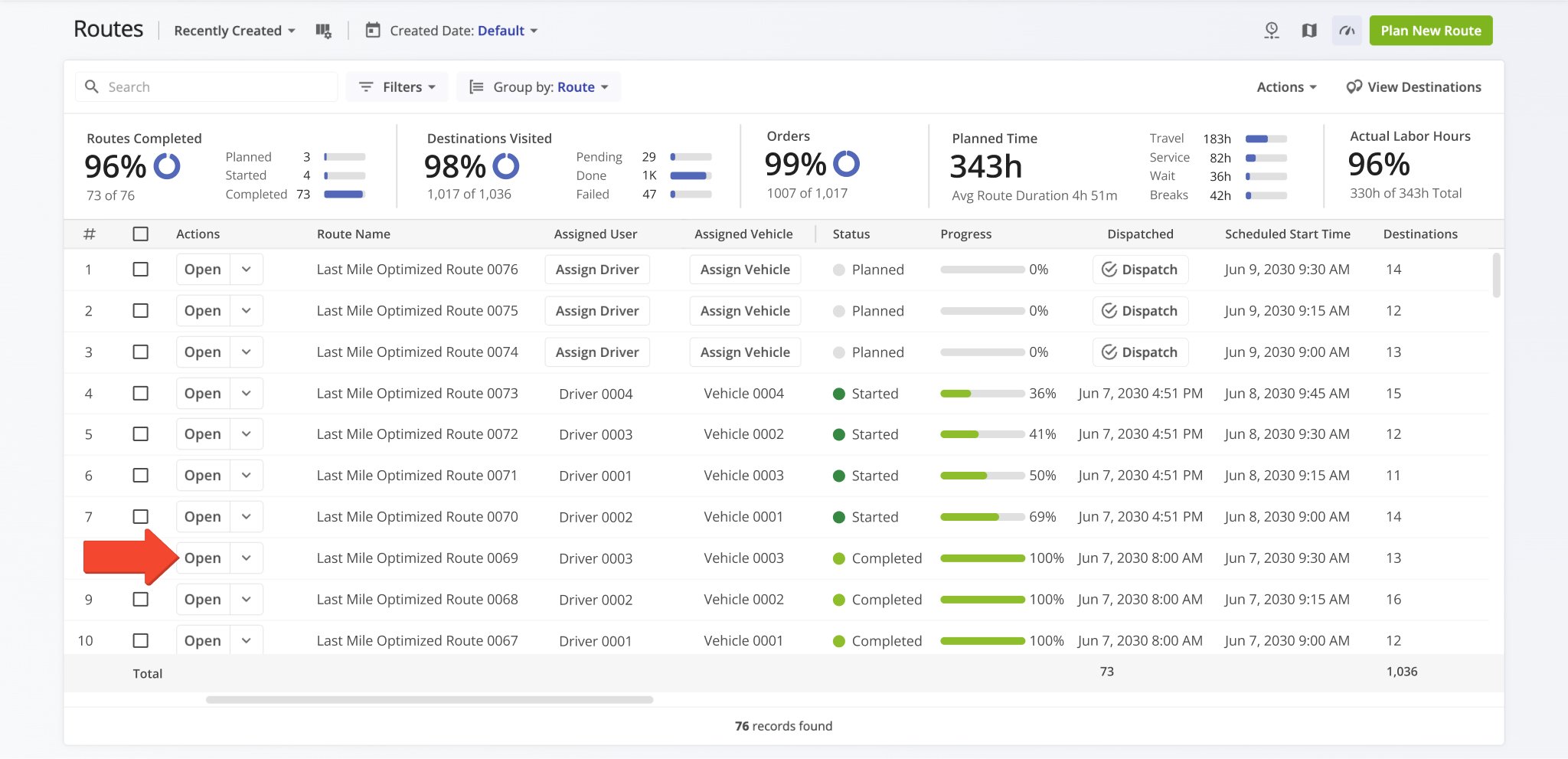
Accordingly, Route4Me’s business route management software will open the selected Route Snapshot.
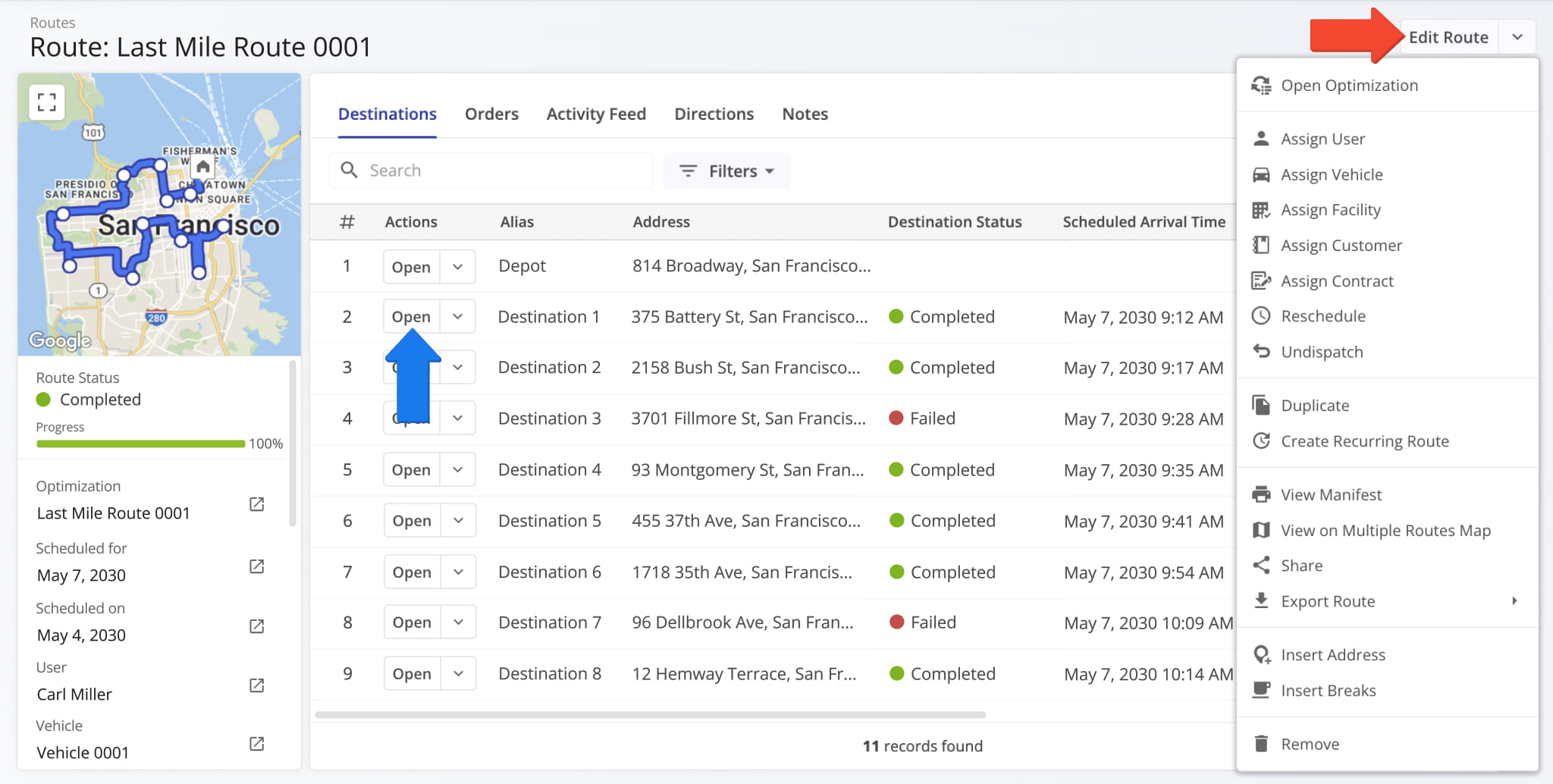
From the Snapshot, you can access the Route Editor, where you can make route adjustments, or click “Edit Route” to assign a User, Vehicle, and Facility, dispatch the route, and execute other route management tasks.
You can also click “Open” next to any route Destination to access its Destination Snapshot.
Route Details Summary – Dynamic Map And Route Information Panel
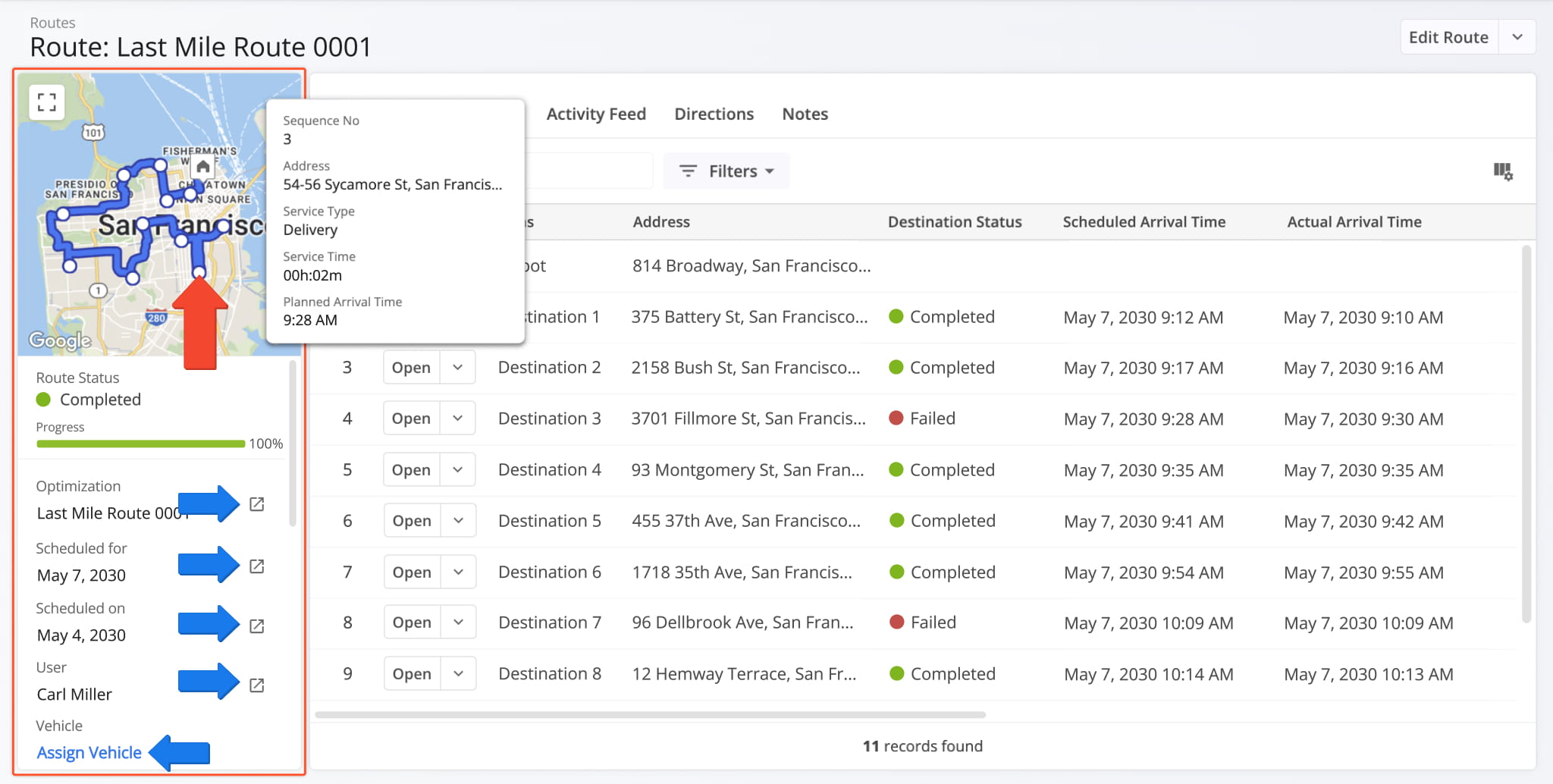
On the left, you can find the Route Summary. The map shows the route’s planned path, including the sequence of destinations. Hover your cursor over any destination to see a summary of its most relevant details.
Below the map, you can find information such as the route’s status, on which date it was scheduled, the assigned user and vehicle, the date the route is scheduled for, etc.
Additionally, you can click the Go-to Icon next to each field to open the respective Route4Me interface. If a field has no associated value or asset, you can click “Assign” to assign one.
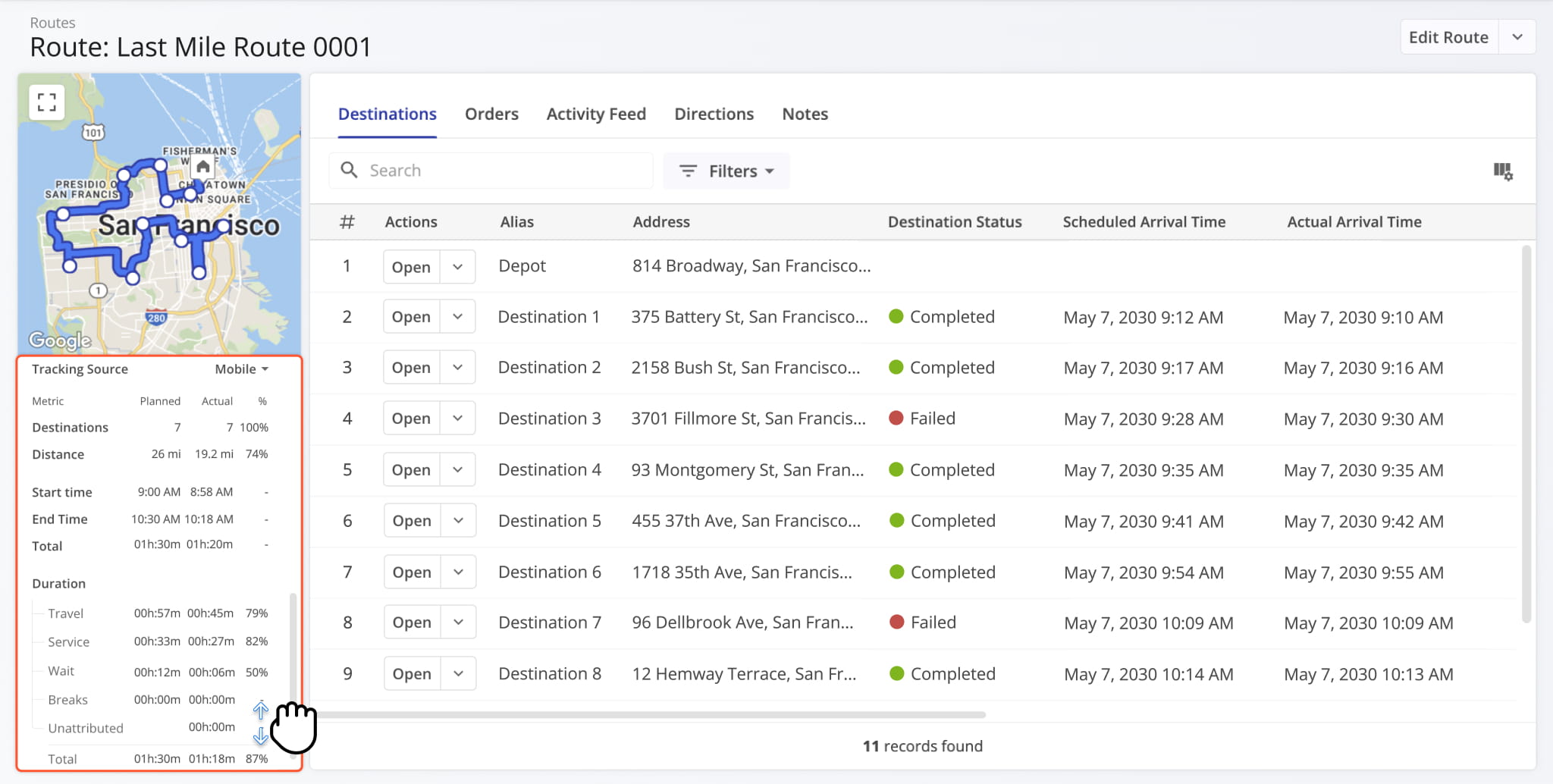
Scroll down in the Route Summary panel to see distance and duration data. Specifically, you can see planned metrics and their actual values after the route is completed or up to the last data sync for started routes, including the difference as a percentage.
Route Snapshot Categories – Route Data Tabs On Analytics Overview Page
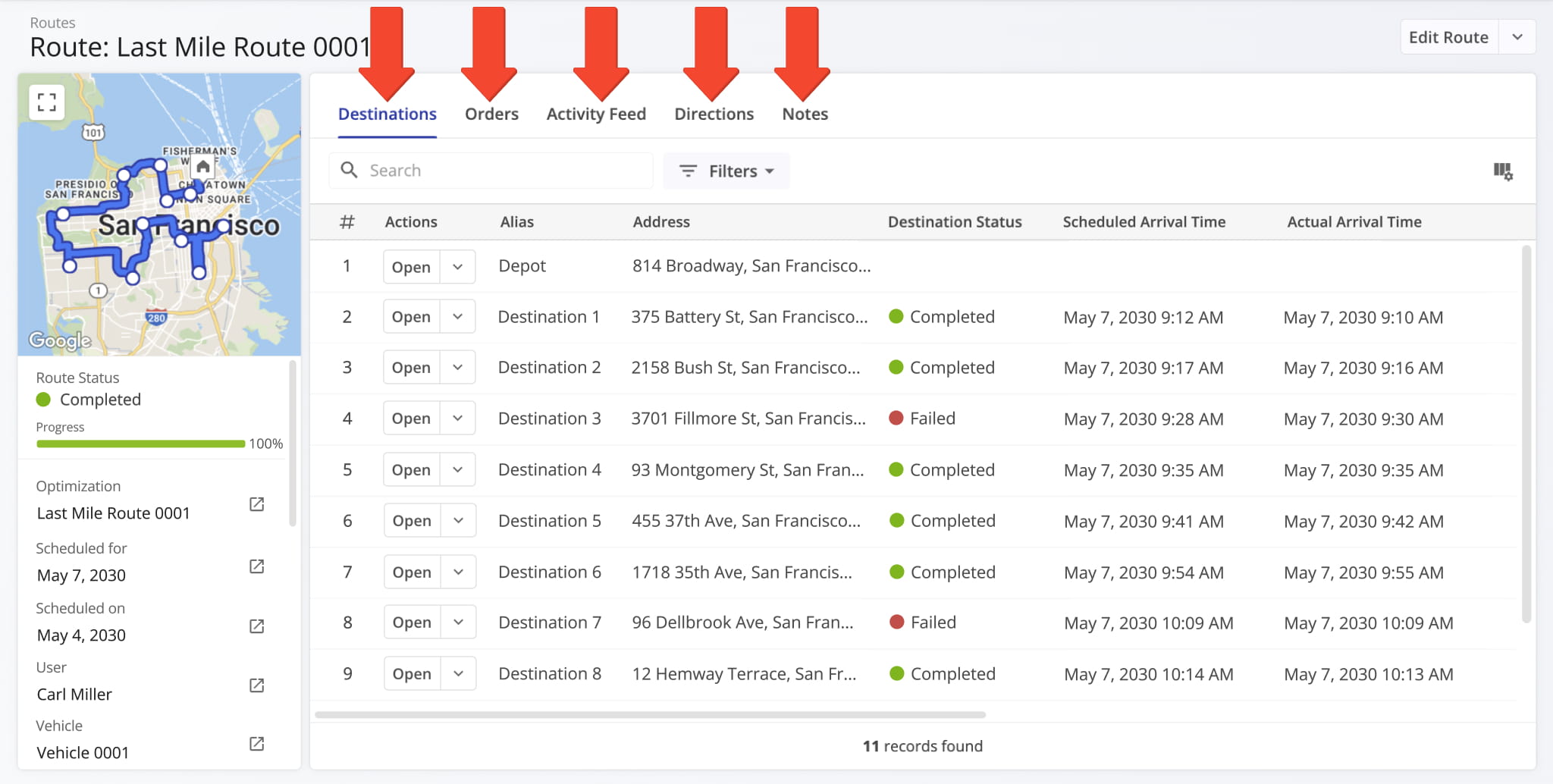
The Route Snapshot has different tabs (categories) corresponding to the type of associated data. By default, the “Destinations” tab is open when you access a Route Snapshot to give you a detailed look at the route’s destinations in the customizable data table.
Learn more about the different route data categories available on the Route Snapshot in the table below.
| Data Tab | Description |
|---|---|
| Destinations | Route Destinations data table where you can view, sort, and customize the displayed destination and customer information. The available destination data on the Route Snapshot is the same as Destination View Mode on the Routes Page. |
| Orders | Customizable data table for orders associated with the route. The available order data on the Route Snapshot is the same as your Orders Page. |
| Activity Feed | Chronological list of route activity events such as destination status updates, changes made in the Route Editor, and more. The available route activity entries on the Route Snapshot are the same as your regular Activity Feed. |
| Directions | List of route navigation directions, including route navigation events, turns, and distance. |
| Notes | List of Destination Status Notes added to destinations by the assigned User, including text notes and links to any associated media (photos, videos, etc.) if applicable. |
Filter Route Snapshot – Find And Filter Route Data On Snapshot Page
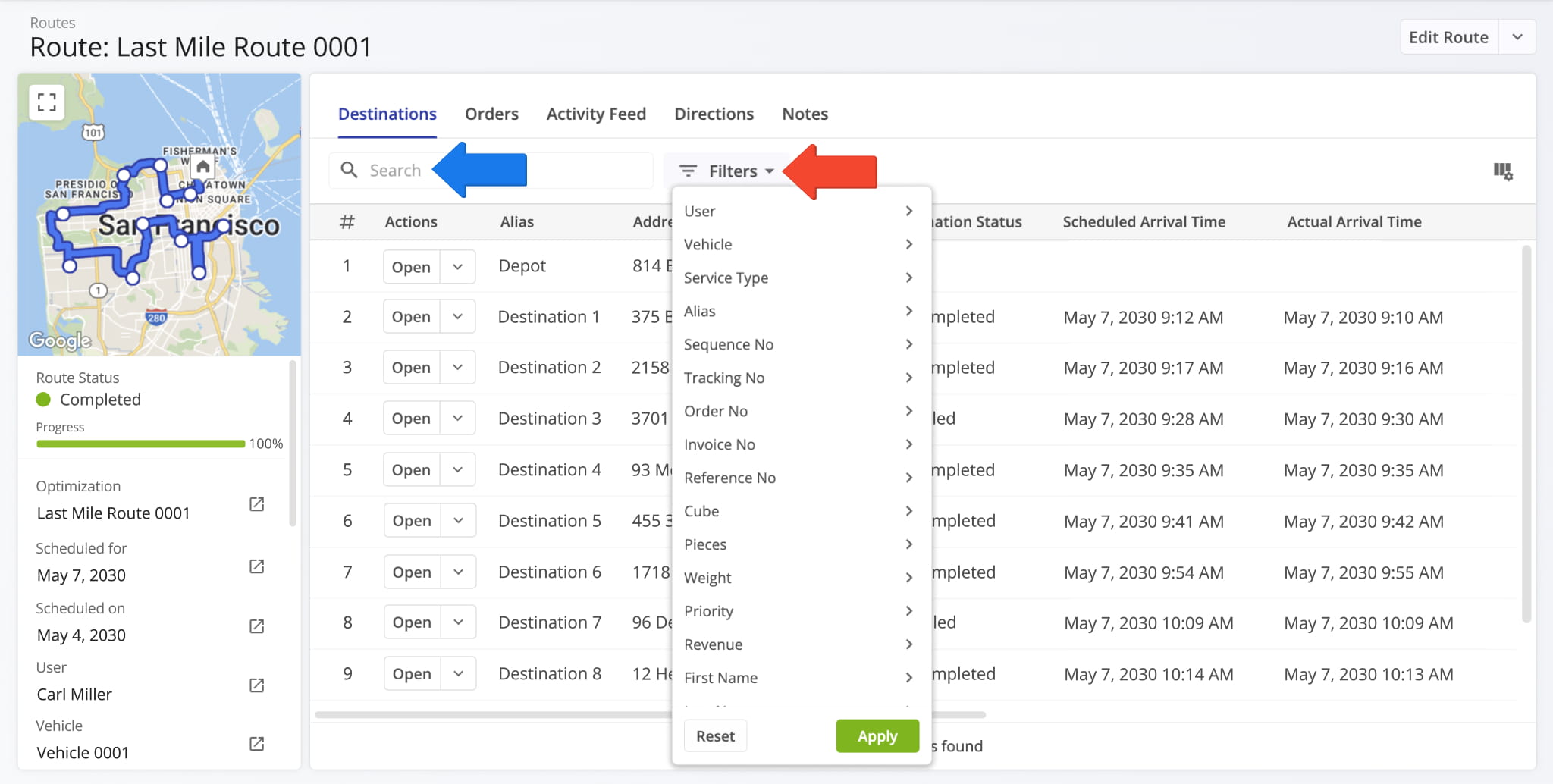
As with every Route4Me data interface, you can search and filter the Route Snapshot to show only the data most relevant to your needs or unique use case.
Simply click the “Filters” button and enable your preferred filtering options, or use the “Search” field to find specific data entries by inputting any of their associated information.
NOTE: The different tabs in the Route Snapshot support different filter settings and options corresponding to the type of data in the respective tab.
Route Data Table – Customize And Re-Order Route Snapshot Data Columns
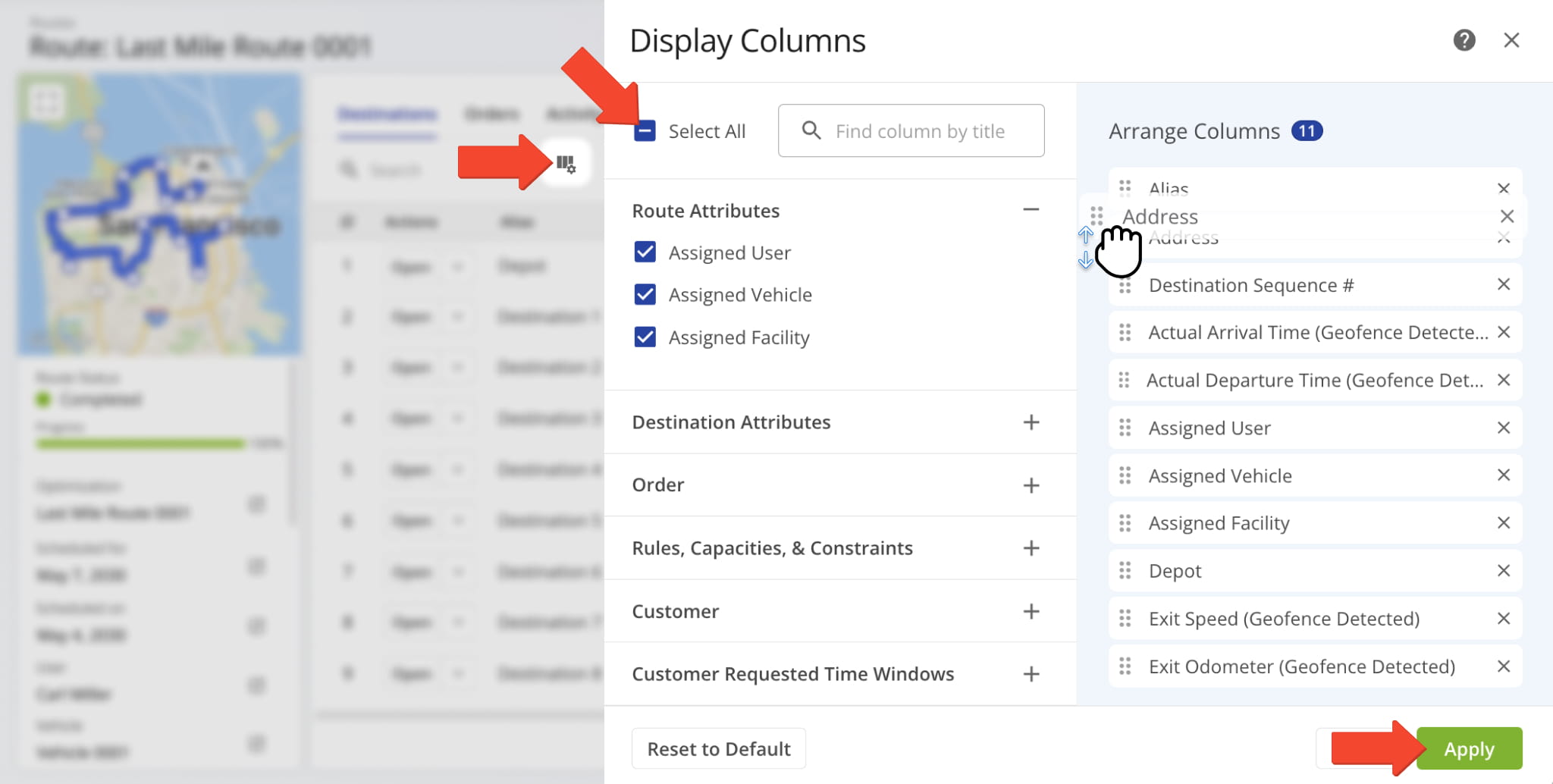
You can customize which columns appear in your Route Snapshot. Click the Display Columns Icon and check the boxes for the columns you want to show. To reorder columns, drag them to the desired position, then click “Apply” to save your changes.
The table below provides detailed information on each available data column.
| Data | Description | |
|---|---|---|
| Route Attributes | ||
| Assigned User | The user responsible for the route, typically the driver or team completing it. | |
| Assigned Vehicle | The vehicle assigned to the route for tracking and capacity purposes. | |
| Assigned Facility | The facility associated with the route, usually serving as the start or end location. | |
| Destination Attributes | ||
| Depot | The starting location or home base for the route. | |
| Destination Sequence # | The planned order of this destination within the route, indicating the sequence the driver should follow. | |
| Address | The full street address of the destination for delivery or service. | |
| Alias | A custom name or shorthand identifier for the destination to simplify identification. | |
| Service Type | The type of service or delivery expected at the destination, e.g., pickup, drop-off, or service call. | |
| Status | The current status of the destination (e.g., pending, in progress, completed, failed). | |
| Timezone | The time zone of the destination, used for accurate scheduling of arrivals and departures. | |
| Distance to Next Destination | The driving distance from this destination to the next stop on the route. | |
| Drive Time to Next Destination | The estimated travel time from this destination to the next stop, based on planned routing. | |
| Man-Hours | Employee working hours required for completing the destination visit. | |
| Order | ||
| Order ID | Unique identifier for the order in the system. | |
| Tracking Number | The shipping or tracking number associated with the order for logistics purposes. | |
| Order Number | Reference number assigned to the order by the system or customer. | |
| Invoice Number | The invoice number linked to the order. | |
| Reference Number | Additional reference or internal tracking number associated with the order. | |
| Rules, Capacities, & Constraints | ||
| Priority | The priority level of the order or destination, which may affect route sequencing. | |
| Cube | The volume of items for the destination, used for vehicle load planning. | |
| Pieces / Units | The total quantity of items or units for delivery or service at the destination. | |
| Weight | The total weight of items for the destination, used for vehicle capacity planning. | |
| Revenue | The expected revenue associated with completing the order at the destination. | |
| Customer | ||
| Customer | The name of the customer receiving the service or delivery. | |
| First Name | Customer’s first name for identification and communication purposes. | |
| Last Name | Customer’s last name for identification and communication purposes. | |
| Customer’s email address, used for notifications or tracking updates. | ||
| Phone | Customer’s phone number, used for notifications or communication. | |
| Customer PO | The customer’s purchase order number associated with the order. | |
| Group | A classification or grouping of the customer, often used for reporting or filtering. | |
| Customer Requested Time Windows | ||
| Time Window 1 | The first requested time window for service at the destination. | |
| Time Window 2 | The second requested time window for service, if applicable. | |
| Schedule & Time Adherence (Travel) | ||
| Actual Arrival Time (User Actioned) | The arrival time recorded manually by the user. “User Actioned” means it was entered or confirmed by a person rather than automatically detected. | |
| Actual Departure Time (User Actioned) | The departure time recorded manually by the user. | |
| Schedule & Time Adherence (Service) | ||
| Planned Service Time | The expected duration of service at the destination based on planning. | |
| Actual Service Time (User Actioned) | The service duration recorded manually by the user, reflecting the real-world time spent completing the service or delivery. | |
| Geofence Detections | ||
| Actual Service Time (Geofence Detected) | The service duration automatically recorded when the user is within the destination geofence. | |
| Actual Arrival Time (Geofence Detected) | The arrival time automatically detected when the vehicle enters the geofence. | |
| Actual Departure Time (Geofence Detected) | The departure time automatically detected when the vehicle exits the geofence. | |
| Entry Speed (Geofence Detected) | Vehicle speed upon entering the geofence, useful for safety and compliance tracking. | |
| Entry Odometer (Geofence Detected) | Odometer reading when the vehicle enters the geofence. | |
| Exit Speed (Geofence Detected) | Vehicle speed upon leaving the geofence. | |
| Exit Odometer (Geofence Detected) | Odometer reading when the vehicle leaves the geofence. | |
| Device ID (Geofence Detected) | The identifier of the device that recorded the geofence event. | |
| Vehicle ID (Geofence Detected) | The identifier of the vehicle associated with the geofence detection. | |
| Telematics Vehicle ID (Geofence Detected) | The telematics-assigned vehicle ID used to track geofence events. | |
| Arrival and Departure Status | ||
| Arrived | Indicates whether the destination has been marked as arrived, either manually or via geofence detection. | |
| Departed | Indicates whether the destination has been marked as departed, either manually or via geofence detection. | |
| Arrival and Departure Time | ||
| Planned Arrival Time | The scheduled time for arrival at the destination based on route planning. | |
| Planned Departure Time | The scheduled time for departure from the destination. | |
| Actual Arrival Time (User Actioned) | The user-recorded arrival time at the destination. | |
| Actual Departure Time (User Actioned) | The user-recorded departure time from the destination. | |
| Dynamic Arrival Time | The estimated arrival time that adjusts in real-time based on traffic or route changes. | |
| Dynamic Departure Time | The estimated departure time that adjusts in real-time based on traffic or route changes. | |
| Arrival/Departure Schedule Deviation | ||
| Time Window Violated (User Actioned) | Indicates if the arrival or departure fell outside the scheduled time window, as recorded manually. | |
| Arrival Time Variance (-Early,+Late) (User Actioned) | The difference in minutes between the planned and actual arrival times, manually recorded. Negative indicates early arrival, positive indicates late. | |
| Departure Time Variance (-Early,+Late) (User Actioned) | The difference in minutes between planned and actual departure times, manually recorded. Negative indicates early departure, positive indicates late. | |
| Planned Remaining Capacity | ||
| Planned Remaining Cube | Estimated remaining volume capacity of the vehicle after servicing this destination. | |
| Planned Remaining Pieces | Estimated remaining item/unit capacity of the vehicle after servicing this destination. | |
| Planned Remaining Revenue | Expected remaining revenue after servicing this destination. | |
| Planned Remaining Weight | Estimated remaining weight capacity of the vehicle after servicing this destination. | |
Visit Route4Me's Marketplace to Check out Associated Modules:
- Operations
Audit Logging and Activity Stream
- Operations
Custom Data Add-On
- Operations
Advanced Team Management Add-On
Last Updated:
About author: Kristian Andreev